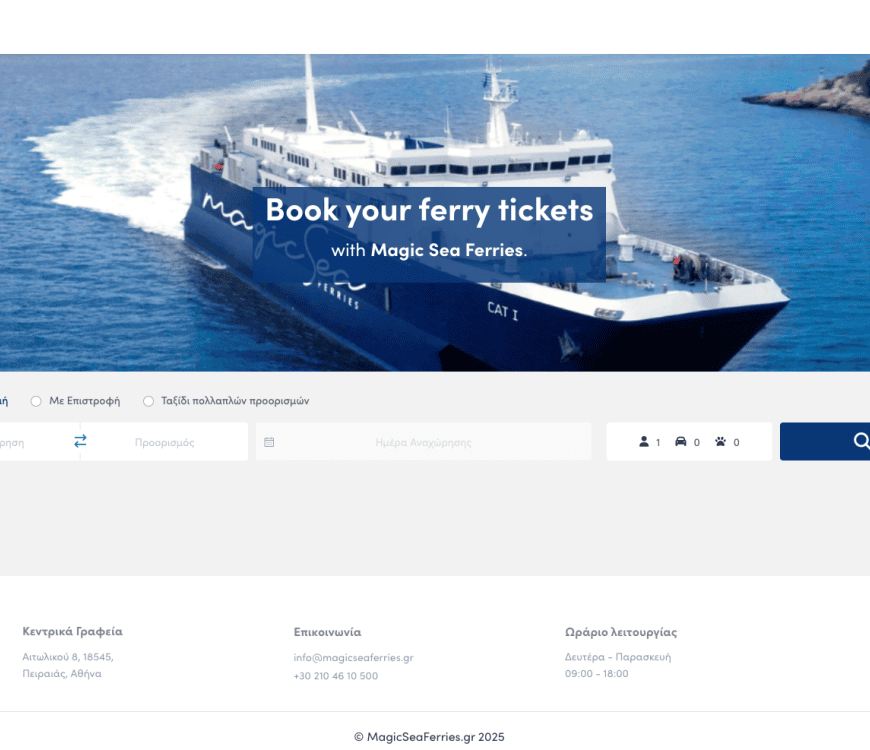
When Magic Sea Ferries joined Boötes as our first ferry operator, the goal wasn't just a working booking site — it was a ticketing system that could survive a full Greek summer at scale. One season in, the platform has processed thousands of bookings across the network and handled complex open tickets and date changes without manual back-office work.
What we built for Magic Sea Ferries
Boötes now powers Magic Sea Ferries' end-to-end digital ticketing — from search to boarding pass, every step runs on the same engine.
- Ferry booking engine with real-time availability, schedules and pricing across every Magic Sea route.
- Web check-in for a fast, seamless boarding experience that takes pressure off port counters.
- Unified back-office for sales, reporting, refunds and customer service, all from one dashboard.
A high-volume summer on Boötes
The first peak season told us the most. Across the summer, the platform processed thousands of ferry bookings through Magic Sea Ferries' web channels — including the heavy-load weeks when every island is in motion.
What we're proudest of isn't only the volume. It's that the harder ferry-ticketing edge cases — the ones that traditionally generate the most call-centre work — were absorbed by the engine itself, not by manual triage.
Open tickets, handled inline
Open tickets are a fact of life for Greek ferry travel: passengers book flexibility, then come back days or weeks later to lock in a specific sailing. Boötes manages the full lifecycle — issue the open ticket at booking, redeem it later against any eligible sailing, validate seat availability and any price difference automatically, and reissue a final boarding ticket — all without taking the customer off the website.
Date changes without back-office bottlenecks
Plans change, especially during high season. Boötes lets passengers change their travel date directly from their reservation: the engine checks availability on the new sailing, applies any fare difference, charges or refunds the delta, and reissues the ticket. No call to the agency, no manual re-booking — and crucially, no risk of double-booking the same seat.
Why this matters for ferry operators
Most ferry booking engines treat tickets as static line items. The Greek market doesn't work that way: open tickets and same-day date changes are the rule, not the exception. Building Magic Sea Ferries on Boötes proved that a modern ferry ticketing platform can absorb that complexity — at peak summer volume — without forcing operators back to spreadsheets and phone calls.
If you run a ferry company and you're still piecing together booking and ticketing across separate systems, the Magic Sea Ferries build is a working blueprint: one engine, one back-office, one customer record, with the operational edge cases handled at the platform level.
Want to see how this would look on your routes? Explore Boötes or talk to us.